
Indian economy grew by 7.8 per cent in April-June -- the highest in five quarters -- before the disruptive US tariffs were imposed.

The United Nations has revised downward India's economic growth forecast for 2026 to 6.4 per cent from an earlier 6.6 per cent, attributing the change to global uncertainties and economic shocks stemming from the ongoing West Asia crisis.

Morgan Stanley believes that the factors responsible for the weak GDP growth include poor agricultural growth, weak investment trend, sluggish domestic market growth outlook and weakness in the service sector.

Moody's Ratings on Friday said with a 7 per cent GDP expansion in 2025 and 6.4 per cent in the next year, India will lead growth among emerging markets and across the Asia Pacific region.

S&P Global Ratings projects India's economic growth to slow to 6.6 per cent in FY27, down from 7.7 per cent in FY26, citing energy stress and a potential sub-par monsoon.
The Indian economy is likely to grow at 7.4 per cent in 2025-26, up from 6.5 per cent in the previous fiscal, mainly on account of better performance of manufacturing and services sectors, as per the government data released on Wednesday.

The Indian economy will grow at around 6.5 per cent in the current fiscal, notwithstanding high crude oil prices and increased uncertainty due climate changes, NITI Aayog member Arvind Virmani said on Thursday. Virmani also asserted that the gross household savings ratio in India has consistently gone up. In an interview with PTI, he said: "My growth projection (of India's GDP growth) is 6.5 per cent plus minus 0.5 per cent... because my experience is that the fluctuations in global GDP more or less has balanced out for us, assuming normal changes."
India's GDP growth rate will rise to 7 per cent by 2026 compared to 4.6 per cent for China, S&P Global Ratings said on Tuesday. In a report titled 'China Slows India Grows', S&P said it expects Asia-Pacific's growth engine to shift from China to South and Southeast Asia. "We project China's GDP growth to slow to 4.6 per cent in 2024 (2023: 5.4 per cent), edge up to 4.8 per cent in 2025, and return to 4.6 per cent in 2026.

Chief Economic Advisor V Anantha Nageswaran on Thursday said economic activity in some sectors have picked up pace during October-November and a GDP growth of 6.5-7 per cent in the current fiscal is feasible.

The Interim Budget for 2024-25 (FY25) to be presented on February 1 is likely to assume 10-10.5 per cent nominal gross domestic product (GDP) growth against 8.9 per cent estimated for FY24 by the National Statistical Office (NSO). "We were waiting for the First Advance Estimates GDP numbers for FY24. "We will finalise the nominal GDP growth assumption for FY25 Interim Budget in a couple of days.
India Ratings and Research predicts the Reserve Bank of India (RBI) will maintain the repo rate at 5.25 per cent throughout FY27, despite potential inflationary pressures from higher fuel prices, with inflation expected to remain within the central bank's tolerance band.

Improvements in industrial activity and services sector mainly seems to have boosted GDP growth.

A NITI Aayog report outlines India's potential to scale its bioeconomy to USD 691 billion by 2035 and USD 2.6 trillion by 2047, creating over 30 million high-value jobs. The report stresses the need for coordinated national execution, regulatory reforms, a strengthened talent pipeline, and a significant BioEconomy Growth Fund to achieve this vision, positioning India among the top biotechnology powers globally.

'... to see that young people are gainfully employed. After that, it will become very difficult as we will start ageing much more rapidly.' 'We have a huge proportion of Gen Z. After 2030, every year, we will start seeing a gradual shift towards a slightly older society.'
Deloitte India on Thursday projected India's economy to grow 6.7-6.9 per cent in the current fiscal amid buoyant demand and policy reforms. Indian economy grew 7.8 per cent in the April-June quarter of current fiscal.

A joint study by IBM and IndiaAI, a MeiTY initiative, indicates that Artificial Intelligence (AI) has the potential to contribute over USD 500 billion to India's economy by 2030. The report highlights the need for improved AI literacy, infrastructure, and data quality to fully realise this potential.

Fitch Ratings on Wednesday raised India's GDP growth forecast to 6.9 per cent for current fiscal year, from 6.5 per cent earlier, citing strong June quarter growth and domestic consumption-led demand.

Amid rising global commodity prices and high inflation, the government is likely to scale down India's GDP growth projection for the 2011-12 financial year next month from 9 per cent estimated in February, chief economic advisor Kaushik Basu on Friday said.
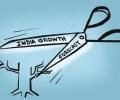
Global forecasting firm Oxford Economics on Monday revised downwards its India GDP growth forecast for 2021 to 10.2 per cent from 11.8 per cent previously, citing the country's escalating health burden, faltering vaccination rate and lack of a convincing government strategy to contain the pandemic. Oxford Economics also said that notwithstanding the likelihood of further mobility restrictions, it expects India's targeted lockdown approach, less stringent restrictions, and resilient consumer and business behaviour to mitigate the economic impact of the second wave.

The World Bank on Tuesday revised upwards its GDP growth forecast for India to 6.9 per cent for 2022-23, from 6.5 per cent earlier.

A prolonged supply shock can transmit to lower incomes, and dampen confidence and sentiment, warns Aditi Nayar, chief economist, head-research and outreach, ICRA.
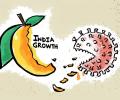
The International Monetary Fund (IMF) on Tuesday cut its economic growth forecast for India to 9.5 per cent for the fiscal year to March 31, 2022 as the onset of a severe second COVID-19 wave cut into recovery momentum. This forecast for 2021-22 is lower than the 12.5 per cent growth in GDP that IMF had projected in April before the second wave took a grip. For 2022-23, IMF expects economic growth of 8.5 per cent, larger than the 6.9 per cent it had projected in April.

India's GDP had recorded 7.5 per cent growth in the April-June quarter of last fiscal.

"This has been powered by a rebound in the agricultural sector following the drought in 2009-10, and a sharp pick-up in private consumption and gross fixed capital formation," CMIE said.

FY17 GDP growth faces cash crunch heat

A NITI Aayog report indicates that India's digital public infrastructure (DPI) initiatives are projected to contribute significantly to the nation's GDP, potentially reaching 4 per cent by 2030.

India's GDP growth will be 7.5% this year: Jaitley

The Indian equity market is set for an event-heavy week, with analysts pointing to the Reserve Bank of India's (RBI) interest rate decision, developments in the US-Iran situation, and crude oil prices as the primary determinants of market trends.

Arundhati Bhattacharya, Salesforce President and CEO for South Asia, stated that cloud and AI are democratising capabilities, offering India a unique opportunity to leapfrog in technology. Speaking at the IMC Chamber of Commerce, she emphasised that AI will create more jobs and urged Indian businesses to transform using technology, rather than merely digitising. She also highlighted the significant economic potential of AI adoption for India.

A new report by FICCI, BCG, and IBA outlines that India's banking sector must grow significantly faster than nominal GDP to support a USD 30 trillion economy by 2047, requiring banking assets of USD 45 trillion. The report highlights the sector's current strength, challenges in digitisation, and the need to enhance resilience against fraud and cyber threats, proposing a 13-point agenda for stakeholders.
India's economy contracted by 7.3 per cent in fiscal 2020-21. The pandemic, it said, will leave new economic scars and deepen pre-pandemic constraints.

India's economic growth rate decelerated to 6.2 per cent in the October-December quarter this fiscal, mainly due to poor performance by mining, manufacturing and all other sectors, with the exception of agriculture. However, on a sequential basis, the economic growth rate in the third quarter showed improvement over 5.6 per cent recorded in the second quarter.
Against the Reserve Bank of India's (RBI's) projection of 7.1 per cent, India's first quarter (Q1) 2024-25 (FY25) gross domestic product (GDP) growth came in at 6.7 per cent. This is in line with market expectations and significantly lower than the 7.8 per cent recorded in the fourth quarter (Q4) 2023-24 (FY24) and 8.2 per cent in Q1FY24. The quarter witnessed decreased government consumption and investment spending due to the parliamentary election.

India's economic growth slowed to near two-year low of 5.4 per cent in the July-September quarter of this fiscal due to poor performance of manufacturing and mining sectors, but the country continued to remain the fastest-growing large economy, data showed on Friday. The gross domestic product (GDP) had expanded by 8.1 per cent in the July-September quarter of 2023-24 fiscal. The previous low level of GDP growth at 4.3 per cent was recorded in the third quarter (October-December 2022) of financial year 2022-23.
The forthcoming Budget could think of maintaining public capital expenditure at 3 per cent so that domestic resources are available for private investments, points out N R Bhanumurthy.
Domestic rating agency Icra on Monday revised its FY24 GDP growth forecast to 6.5 per cent from 6.2 per cent earlier. However, the revised forecast is still much lower than the Reserve Bank of India's (RBI's) 7 per cent real Gross Domestic Product (GDP) growth estimate for the ongoing fiscal. Earlier this month, the RBI had revised upwards its GDP estimate to 7 per cent from 6.5 per cent, calling the revised number a "conservative" one.

Reserve Bank on Wednesday cut India's growth forecast to 6.5 per cent from 6.7 per cent estimated earlier for the current financial year on account of impact of global trade and policy uncertainties. Prospects of agriculture sector remain bright on the back of healthy reservoir levels and robust crop production in 2025-26, RBI Governor Sanjay Malhotra said while unveiling the outcome of the first bi-monthly Monetary Policy Committee meeting for the current financial year.

Foreign portfolio investors (FPIs) have injected Rs 30,919 crore into Indian equities in August, marking their second consecutive month of net buying. This follows a Rs 20,200 crore investment in July, indicating a potential reversal after four months of significant outflows, driven by improving corporate earnings, resilient economic activity, and a stable rupee.

India's net direct tax collection has surged by 13 per cent to over Rs 12.12 lakh crore by September 17 in the current fiscal year, driven by a significant increase in advance tax payments from corporates, according to CBDT data.

The Reserve Bank of India on Friday revised upwards the GDP growth projection for the current fiscal to 7.2 per cent from 7 per cent on rising private consumption and revival of demand in rural areas. Unveiling the bi-monthly monetary policy, RBI Governor Shaktikanta Das said estimates released by the National Statistical Office (NSO) placed India's real gross domestic product (GDP) growth at 8.2 per cent in 2023-24. "During 2024-25 so far, domestic economic activity has maintained resilience," he said, adding that manufacturing activity continues to gain ground on the back of strengthening domestic demand.
